A One-Page Question List for a Routine Appointment
A one-page question list for a routine appointment helps you sort competing concerns, record useful answers, and leave with a clearer sense of what remains.
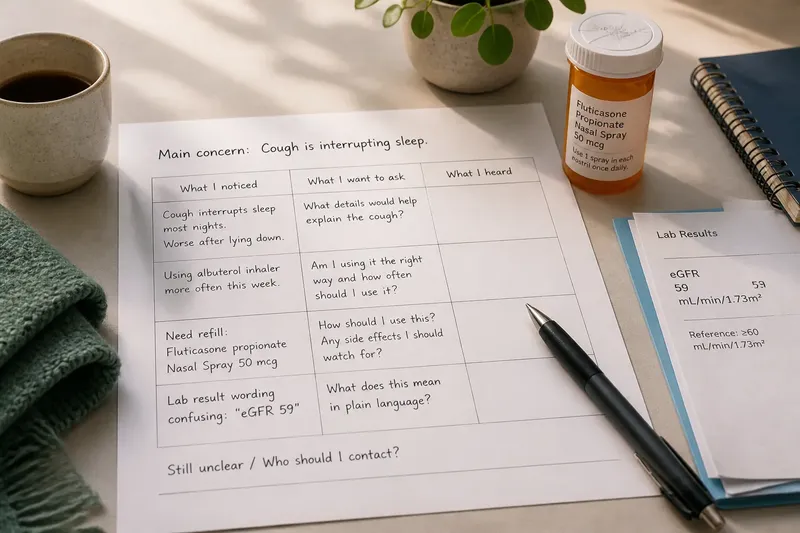
What belongs on a one-page question list for a routine appointment when several concerns compete for space? One page is enough to name the issue you most want addressed, supply a few useful details, and leave room to capture what you learn. Its job is to preserve your own context, not to script the visit.
Instead of organizing the page around the order a conversation might follow, build it around the information you may need to recall: what changed, what you have noticed, and what you want clarified. This makes the sheet useful even if the conversation takes an unexpected direction.
Start with your main concern
Write one plain-language sentence at the top that says what you most want help understanding. “My cough is keeping me awake” gives more context than “cough,” while leaving the clinician room to ask for details and explain possible next steps.
Under that sentence, add only details that help you describe the concern accurately. Depending on the issue, these might include when you first noticed it, what seems to bring it on, or what has changed. If you are unsure about a detail, mark it as uncertain rather than filling the gap with a guess.
Keep the wording easy to say aloud. A prompt such as “What might explain the change?” can be more useful than a long paragraph that tries to anticipate every possible answer.
Use a context-and-question grid
Draw three simple columns on a sheet of paper, or use three labels in Apple Notes, Google Keep, or another notes app: “What I noticed,” “What I want to ask,” and “What I heard.” The first column holds brief observations, the second holds the question they prompted, and the last stays blank until the conversation.
This structure keeps your own account separate from the answer you receive. It also makes it easier to see whether a question needs a specific detail, without turning your notes into a full medical history.
- If a concern has a clear recent change, write the change in “What I noticed”; then ask about that change rather than using a broad label.
- If you cannot recall when something began, mark the timing as uncertain; then describe what you do remember instead of guessing.
- If a medicine name or instruction is hard to read, copy the wording from the label or document; then ask what the term means rather than interpreting it yourself.
- If two questions concern the same issue, combine them under one prompt; then use the note space to capture any parts that remain unanswered.
- If a concern does not fit a clear topic, write it in ordinary words; then keep it on the page rather than forcing it into a medical-sounding category.
- If a question depends on another person's observation, note who noticed it and what they saw; then distinguish that account from what you experienced directly.
Leave room for answers
Reserve the right-hand side of each row or a blank area beneath it for notes. You do not need to record every sentence. Capture a few key words, a term you want explained, or an instruction you need repeated.
When an answer is unclear, write a question mark beside the note and ask for clarification while you are still discussing it. For a plan or instruction you may need to remember later, ask whether it can be written down or pointed out in an after-visit summary.
Keep a final line for “Still unclear” or “Who should I contact?” That space is for recording what remains unresolved and the contact route discussed, not for deciding on your own what care should happen next.
Make the page fit
Use a full sheet of paper if handwriting is easiest, or a phone note if you prefer typing. A folded sheet can keep the blank answer area covered until you need it; on a phone, short lines and clear spacing make prompts easier to scan.
Say you have a routine visit coming up and want to raise a recurring cough, a question about a refill, and uncertainty about the wording on a test result. You write “cough interrupts sleep” under “What I noticed,” ask what details would help explain it, and leave the answer column blank. For the refill, you copy the medicine name from its label and ask what you should understand about the instructions; for the result, you copy the unfamiliar wording and ask for a plain-language explanation. The completed page separates your observations from the answers, while leaving room to record anything still unclear.
Prepare without crowding
Before the appointment, check each line against a simple rule: does it help you describe a concern, ask a question, or remember an answer? If two lines serve the same purpose, combine them; if a line is only a guess about what might be wrong, replace it with what you actually noticed or leave it off.
Use terms from a label, message, or document accurately, and make clear when you do not know what a term means. Do not change a medicine or care instruction based on a note you cannot interpret; ask the clinician or another qualified professional to explain it.
If writing is difficult, type or dictate the prompts, or ask someone you trust to help you prepare. Decide whether that person should take notes, help you remember a question, or simply be present, and bring the page in the format you can refer to comfortably.
Questions about the page?
How many concerns should I include?
Include the concerns that matter to you, but give each one enough space to state what you noticed and what you want to ask. If the page becomes crowded, mark the concern you most want to discuss and ask how to raise the others appropriately.
Should I bring medical records?
Bring a document or label if it contains wording you want explained, and identify the part that prompted your question. A clinician can tell you whether additional records are needed for the conversation.
What if I forget a detail?
Mark the detail as uncertain and describe what you do remember. If the missing information matters, ask whether there is another way to check it rather than trying to reconstruct it from memory.
What if I cannot finish the list?
Keep the question that matters most visible and ask which remaining concern can be addressed another way or at another time. The page is a memory aid, not a measure of whether you prepared well.
Keep it useful afterward
After the visit, look over the notes while the conversation is still fresh. Separate what you understood from what remains uncertain, and use the contact route the clinic provided if you need an explanation of the plan.
A one-page question list for a routine appointment works best when it preserves your observations in your own words and gives the answers somewhere to land. The blank space is part of the preparation: it leaves room for information you could not have known to ask about in advance.


